Tuesday, January 7, 2014

Life on the Farm, Polar Vortex edition

I shouldn't really say that I live on a farm. We don't depend on anything we grow or raise for money. In fact, so far we only give things away: eggs to my parents, plants for the gardens in the spring, a little produce. When I refer to this land as "the farm," I use the word in an aspirational sense--someday--and with a hint of the preposterous: no one who knew me in the first, say, 30 years of my life would ever have guessed that I'd be living at a rural address in the Midwest.

For one, it's too cold. That's what I always said. That was before I had experienced the ice storm of a century in 2011 and now the polar vortex of 2014. I like the sun and desert heat. Here's where I live now. I think it's called Canada:


Another reason I would never do what I did a few years ago (leave the Southwest to make a home next door to my parents in Indiana): I'm not really a "hands-on" kind of person. I'm an academic. I bump into walls. How convenient.

Our move here seems abrupt in many senses. In the space of three weeks, we went from admiring the little house we were renting in a cute Arizona town to negotiating the purchase of 21 acres in Indiana. But while our move here was sudden, the decision was weighed carefully. James found a way to work from Indianapolis and I was ready for a radical life change of this sort. I wanted to live on a farm--I braced myself for the mental and physical strain and for the disappointments that inevitably come to those who suddenly decide to do something they know nothing about. I hoped I would weather the trials and stay for the long haul, but I knew moving here was an adventure worth trying either way. Spoken like someone who can afford the luxury of trying and failing, I realize. (I have mad respect for those who go all in, who commit to living off the land, build small farms and take real financial risks. I understand their hunger if I don't share their audacity. Many of us grew up far from a life that asked us to make physical sacrifice, and we want to live, damn it!)

But I want to tip my hat to those folks, just a couple generations ago, who were born into a life of farming, whose hardships were not voluntary. Here's my maternal grandmother and her brother, who grew up on a farm my great-grandpa described as "saved" by the New Deal:
Aren't they cute?

Awww.... Despite her genuine smile in this picture, she says keeping chickens was "gross."
Grandma's stories about the farm keep it real. Her honesty balances my tendency to over-romanticize. The truth is, part of my romanticization comes from her. On the other hand, if I'm honest or remotely in touch with the person I've been for the past 38 years, chickens are super gross. I've got a t-shirt that says so. I still love the weirdos.

And here is my husband James's paternal grandmother:
Apparently the kids tried to neutralize the goat smell with perfume.

Sometimes, people do hard work in brutal conditions because they have no choice. I've been so fortunate: I have had a choice, and until October of 2010, I chose to avoid discomfort and hard physical work. Now, I have put myself in a position where, at least in the past few days, I have had no choice but to live here, endure power outages, be chilled to the bone, and do farm chores all while recovering from a nasty cold (but who's complaining?). Maybe I can allow myself to speak of "life on the farm" from time to time.

I have stood ankle-deep in pine shavings and chicken poop. I've been out in one degree weather filling a five-gallon bucket with water from a frost-free water line for the hens.

James took this photo from the kitchen window
... and now I can say that I have been out in -13 degrees with a -39 windchill, massaging my chickens' combs and wattles to keep their blood flowing and minimize frostbite. I chose this, and can you blame me? I'm getting some awesome war stories.

Sunday, October 6, 2013

Medium

I've been using a website called Medium to post essays. Here are links:

Restless Fourteen Times: The Marvel and the Tyranny of Personal Data
Reflections on the Fitbit Flex, a wristband that monitors calories and sleep.

Rebuilding the Plains: Restoring Pre-Agricultural Land in the Conservation Reserve Program
An account of the first part of our odyssey to convert our hill to a native grass and wildflower site.

I also put two older, previously published essays on Medium because the format is so pretty:

An Ocean of Instance, An Ocean of Law (from 2008)

The Artistic Temperament (from 2004)

Friday, September 20, 2013

Border Collie + Chickens!

Gracie, my parents' Border Collie, is amazing. And exhausting. Living next door to Mom & Dad, their dog quickly became partly our dog. I have bonded with Gracie a lot, and long before we introduced four chickens into our lives.


When the chicks were tiny, we kept her on a leash if we brought them outside and she tugged at the leash, her wolf-like teeth snapping. But she paid attention to us. Border Collies are very amenable to training.


I believe in progress--the proof is right in front of us. The chickens are big enough that they live outside all the time now. And we eventually started letting Gracie roam around without the leash.


This is her one of the first times she put the chickens back in the ark without a leash. (I apologize for the loud wind in the recording.)


I wish I could say it has gone that smoothly since. She sometimes blocks the entrance to the ark and a chicken will circle trying to get in with the others while this big scary dog stands in her way. But she is getting the hang of it.

Of course, at night the chickens put themselves to bed and Gracie's "help" only slows things down, but we're training her. There might be a time when we need to corral them away from a predator, and Gracie's skills could come in very handy.

For now, she herds them all the time.


She watches them very closely. Often too close for comfort. But we know now that even if she makes them nervous, she is not planning her dinner.


Wednesday, September 18, 2013

Modern Farmer and the Ideological Agricultural Divide

There is reason to celebrate. The second issue of Modern Farmer is here! My husband picked it up at Whole Foods on Monday. (It is also available at Tractor Supply. I could subscribe, but buying magazines at Tractor Supply with my chicken feed sounds so cool. The first issue of Modern Farmer made me very happy.) 

The two places I am most likely to buy my copy of Modern Farmer--Whole Foods on one end and Tractor Supply on the other--are quite telling about the range of consumers bound to read the magazine. 

Yesterday's New York Times piece on Modern Farmer, while mostly positive, got one thing wrong. While acknowledging Modern Farmer's unique aesthetic, the piece claimed that “articles report on straight agricultural topics more often found in farming publications like the 111-year-old Successful Farming.” While there may be occasional overlap between the two publications, I doubt there will be many people who read both, due to the fundamental ideological divide in agriculture today.

On the one hand you have the agri-intellectuals (a term of contempt in some circles) or what I call food ideologues, and on the other you have industrial--or conventional, or Big--agribusiness (often the object of my contempt). But if I’m honest, this divide deeply concerns me. 

I don’t pretend to be beyond this divide--as I have described it, one side is made of people (albeit ideologues), and the other is an abstraction: monolithic business. Indeed, many modern agricultural problems stem from greed, and greed on the scale we’re talking is only possible at an impersonal level. (And I’ve tipped my hand with “many modern agricultural problems stem from greed,” because there are many who believe that industrial agriculture is feeding the world. I'm not even going to address that here. I recognize that most of the people driving the combines and sprayers and using mass quantities of commercial fertilizer are decent people. The greed I’m talking about is more subtle, more insidious, and usually attributable to people who spend little time on farms.)

When I moved to this rural address, I automatically started receiving--I stress that I did not subscribe--three eye-opening publications: the aforementioned Successful Farming (a waxy periodical aimed at conventional farmers), AgriNews (a no-nonsense paper reporting on drought conditions and the trend toward cover crops), and Beyond the Bean (straight propaganda put out by the United Soybean Board). All of these have shown me what kinds of concerns industrial farmers have, and there is a broad range. Contrary to what many agri-intellectuals assume, many of them are concerned with soil health, nitrogen runoff, and a few dozen other environmental and health issues.

Still, it was all too clear what Successful Farming was about. Each issue focused mostly on maximizing profits. Sometimes, and definitely in the long run, that aligns elegantly with helping the environment. In the short run, however, planting corn on corn (not rotating with soybeans) because the price of corn is just too sweet this year is considered good advice. 

That’s not the kind of advice you would find in Modern Farmer, which features highly diversified farms. I mean Old MacDonald farms, with a moo-moo here and a cluck-cluck there, but also with robotic scarecrows and Wi-Fi-enabled weather sensors. The modern farm is exciting, innovative, dirty, rewarding, and possibly devastating. Neoclassical and wildly experimental at once--exactly what we need right now. 

Both Successful Farming and Modern Farmer might feature farming apps for your phone. Successful Farming might describe an app that retrieves soil survey data--very cool and very practical. Modern Farmer describes iCow, an animal husbandry app that has gained popularity in Kenya--possibly practical, but wicked cool and with a global focus. Successful Farming magazine profiles mostly white men from the Midwest. Modern Farmer’s Issue #2 opens with a piece about a Lebanese farmer watching Syrian refugees plant eggplant. Sure, there are plenty of white people in Modern Farmer. But there are also profiles of farms staffed by people as diverse as what is grown on them. 

I celebrate Modern Farmer for straddling this divide between food ideologues and actual farmers. Food ideologues are both my favorite and my least favorite people: they are the optimists, the hobby farmers, the intellectuals, but they are often also the most radical and the least flexible (ironically, I mean the least intellectually flexible). Let me be clear: by “actual farmers” I do not mean the guys who carpet most of the county with corn and soybeans every year. I do mean people who work the land and get dirty--not just agri-intellectuals. There is nothing wrong with people who live in the city, read Animal, Vegetable, Miracle or The Omnivore’s Dilemma and grow cilantro in their windowsill. I was that person--still can’t claim to be much more, but I am a work-in-progress. Many people are not able to do much more than have an awareness about our industrial food system and fulfill Wendell Berry’s suggestion (1989) that we “participate in food production to the extent that [we] can.” 

Some people are taking growing food for yourself a step further. It is the first time in human history when more than half the world’s population live in cities than in rural areas. American farmers are getting older on average (pushing 60). To combat these trends, there are grassroots organizations like The Greenhorns (described on their site as a “working to recruit, promote and support the growing tribe of new agrarians”) and publications like Modern Farmer.

Courtney Cowgill, a farmer who has written about farming for The Associated Press, is quoted in the New York Times piece on Modern Farmer: 
“I know they’re trying to reach people like me and the kind of hobbyists and the people who are just kind of enamored with the idea of farming,” … To appeal to the person who wants to romanticize farming and the person who is knee deep in turkey droppings “is hard, and I think they’re balancing that,” she said.
That seems about right. Modern Farmer speaks to those of us who are earnest about walking the walk. Those of us slowly gaining experience with something like actual farming who see a complicated road ahead. 

I have oversimplified and I want to list caveats at every turn. But if I ever want to stop writing, I need a pithy exit: I am still learning. 

Tuesday, September 10, 2013

Winter Chicken Coop In Progress

I almost hate to post any pictures until it's done, but it looks so good! Dad built and painted the box white (what do you call the box where you retrieve the eggs?).

I'm so happy that we were able to salvage this metal that was sitting in the corner of the property for fifteen years, from when they built the barn. Fifteen years in the woods and there was surprisingly little rust. It wasn't hard to clean up at all! Dad has done some creative patchwork and, as with everything with this property, we got lucky.


We're guessing it won't be final until mid-October. There are lots of little decisions about details (what will the little chicken door be made of? how will it hinge? or will it hinge at all? what will we do about a fence? how do we keep it from getting too hot with those windows? how will we insulate here and there for winter?) and we have to wait for several inches of rain and then a dry spell before we can lay the electrical wire from the barn.


Meanwhile, the chickens are hot! (And so are we. Looking forward to the cooler weather and some rain.)

Saturday, August 24, 2013

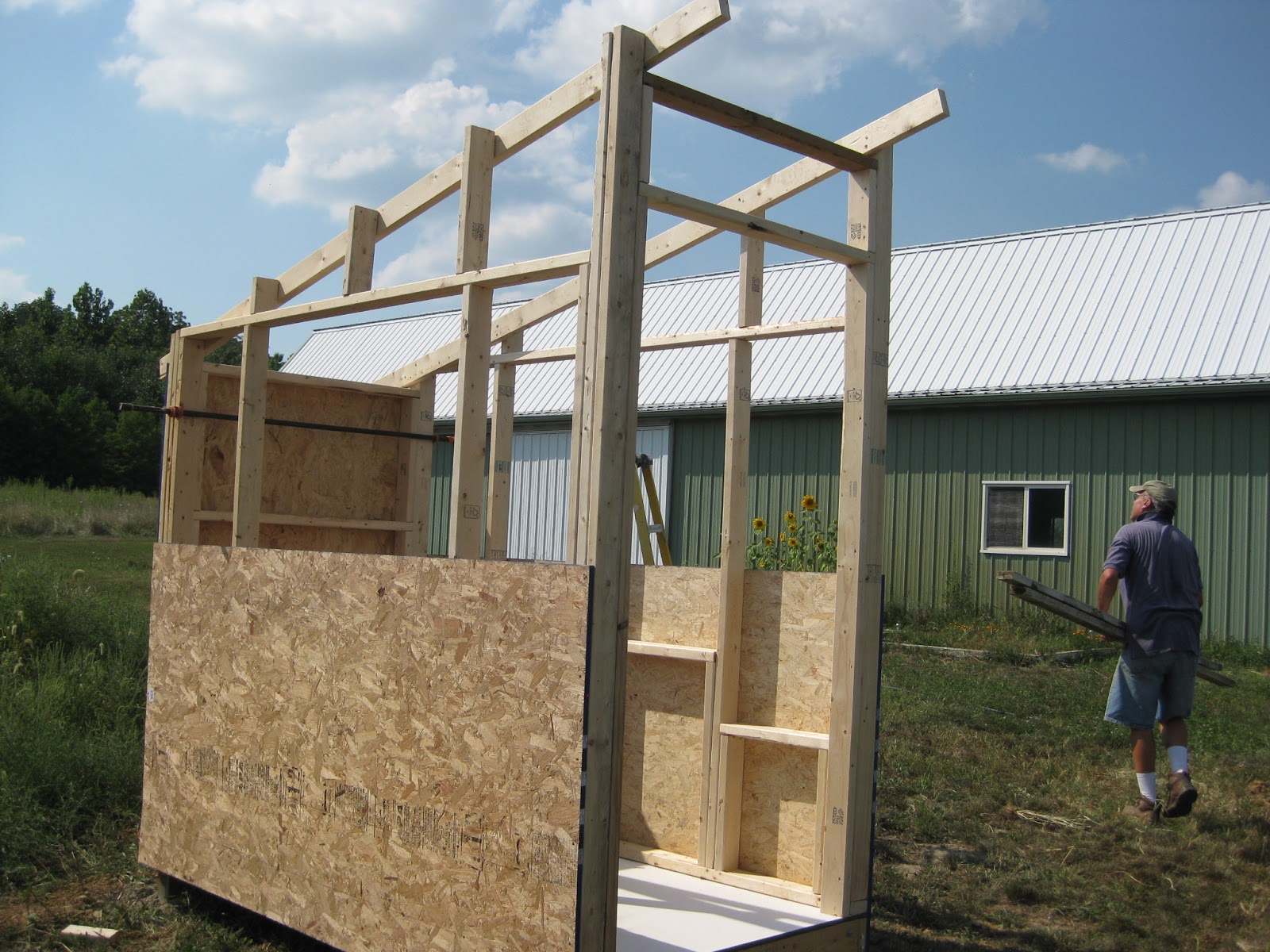
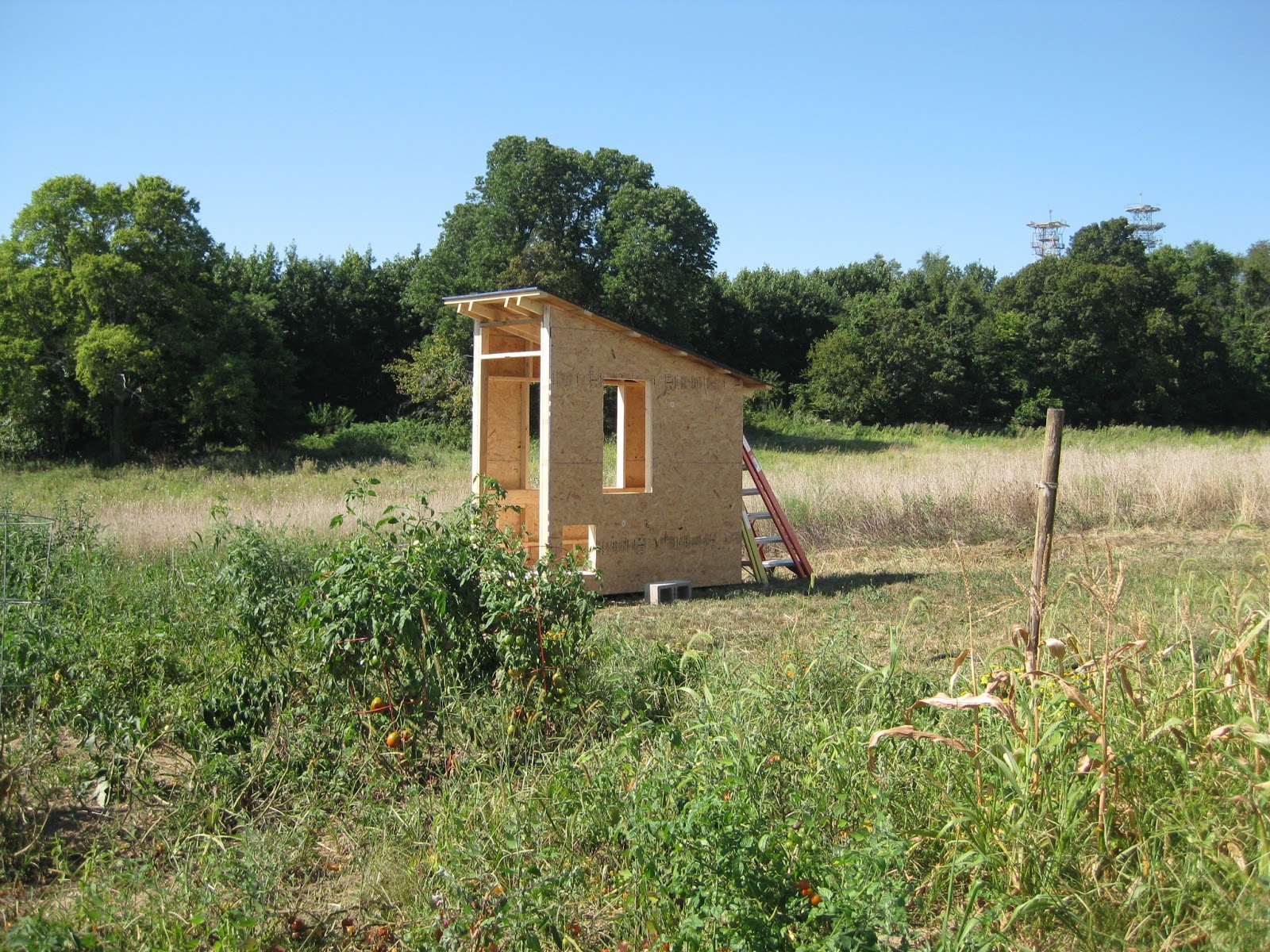
Building the Winter (Permanent) Chicken Coop

Dad's retirement is benefitting me greatly.

Just as we copied the plans for the chicken tractor from the book, Self-Sufficiency for the 21st Century, Dad found a Maine website, Downeast Thunder Farm, with detailed plans for a coop.


It has been hot and we need rain. I think Dad is looking for signs of rain clouds here.


Once again, Dad has been doing all the design and more than his share of the work. (Is it pathetic that the power drill makes my piano-playing forearm shake all evening? Don't answer that.) And again, there have been some key alterations.


One ridiculously awesome alteration: since we recently replaced the windows in our house, Dad has repurposed our old kitchen and laundry room windows for the coop.


This narrow structure will have windows on either side. 

The view the chickens will have of the pond.


In the dead of winter, the chickens will be getting southern exposure, which is nice.


The siding will be metal found in our back woods, leftover from the barn. I'm trying to convince Dad the chickens need a solar hot-water heater. (I don't want to spend too much on electricity, do I? No, I will not go out there several times a day in the freezing cold to change their water.)

To recoup our investment (re-coop?) we would have to charge maybe $10 per dozen eggs for years to come. But my father is out of control! What can be done?

Saturday, August 17, 2013

Indiana Produce for a Santa Fe Feast

August in Indiana. The days are shorter already, and we've had a couple cold snaps. I start to feel a twinge of melancholy, like the whole year is already over. But something absolutely magical works as a countervailing force: the harvest.

Bountiful, Indiana harvest! I am joyful.

Today, I woke up and picked food for lunch and dinner. Lunch will be Italian--Caprese--an easy way to consume our basil and tomatoes raw (we'll only eat my five black tomato favorites: Black from Tula, Brandywine Black, Black Krim, Japanese Trifele, and Nyagous).


Dinner, though, will be chile rellenos made with our Anaheim and Poblano peppers, with salsa verde from our tomatillos, and tomatoes on the side.


Other days, we cook the black beans for a couple hours to make a black bean and corn salsa/salad.

We will try this year to make blue corn tortillas--we have no idea what we're doing, but that's part of the fun.


Yum. Yum. Yum.

James's salsa verde:


(Tomorrow: Margarita Pizza, using sweet, pink Mortgage Lifter tomatoes.)